
Finding familiar grounds: thoughts on Immemorial exhibition curated by Karolina Dworska

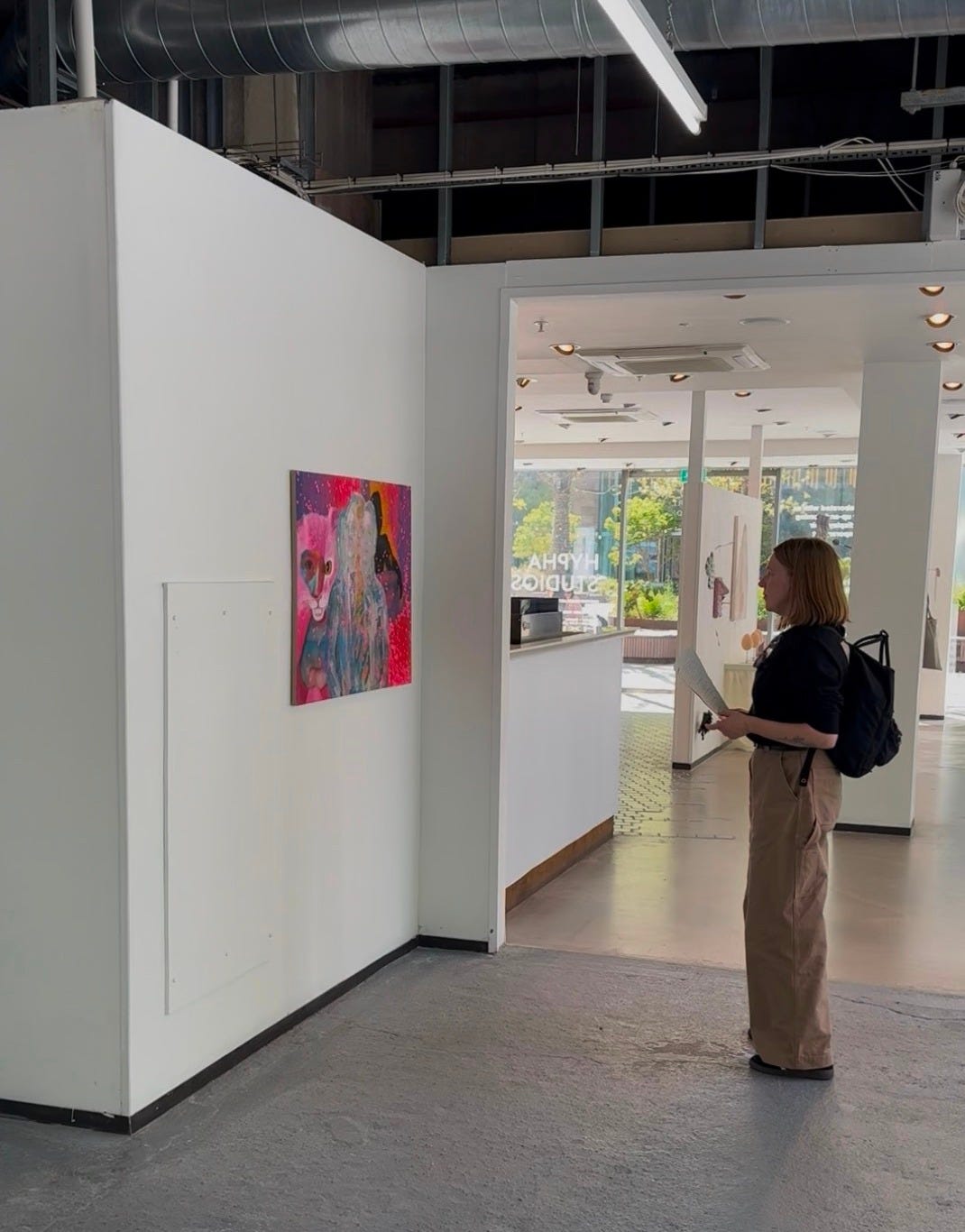
I often say that the most interesting things in art happen when two or more seemingly unrelated ideas, ways of being or ways of thinking, perhaps, meet. There is always a struggle and tension on any frontier. Yet this eternal conflict can also be turned into a creative force and artists are often the best-suited people to find new meanings in this restless deluge of juxtapositions.
It was the case with Hurvin Anderson, who found the new reality on a ledge between his life in the UK and his Jamaican ancestry. As a spectator, I was fascinated by his worlds, but also felt alien within them. Our mythologies, our language beyond words, were too different. I could only engage with his practice on an intellectual level; emotionally, we met on a ground common for all human beings, but our mythologies, these inner threads that can connect people from similar cultural backgrounds, didn’t match. His canvases were not what I could call familiar ground.
I did, however, recently stumble upon such familiar grounds when I visited Immemorial, an exhibition curated by Karolina Dworska. The group show brings together UK-based artists with Central and Eastern European roots, members of the S.E.E.ANEW collective. The central theme is a concept of home and its fluidity. The exhibition text gestures toward migrant experience, evoking “fluidity of identity” and a “shifting sense of belonging” but it doesn’t elaborate any further. It intrigued me, but I remained cautious: the text was brief—too brief—and group exhibitions of emerging artists can often feel unfocused, prioritising visibility over coherence.
To my surprise, I left the gallery uplifted, pleased with what I saw. The show is not without flaws—some works are stronger than others—but its weakest point lies in its communication. The text is too brief and feels like wasted potential: there are so many threads and themes running through this show - write about it, make it into an engaging story that will bring more viewers in and not only art school friends and friends of your friends!
One thread quickly becomes apparent: the artists share overlapping mythologies which, intentionally or not, point to common dilemmas and longings. Many works reference folklore, such as the fantastic painting She is the House by Lena Brazin, or the somewhat dark Barstuks by Cieszymir Bylina. Brazin’s Baba Yaga, though colourful and even wearing a seductive smile, is unsettling—carrying that same fear I felt as a child imagining the house on chicken legs hidden deep in the woods...
The Barstuk, a dwarf from Warmian folk legends, is also dark and disturbing in Bylina’s painting. Or perhaps he is simply sad and lost? These creatures used to inhabit burrows dug at the edge of fields and orchards, or nooks between tree roots, living in harmony with people who left their dwellings in peace.
Where do the Barstuks hide now? There is no longer a patch of land left untouched by human hands; where could they possibly have their burrows and homes? Among the trash scattered alongside roads, beside busy highways? This sense of sadness or longing for the wild nature runs through other works in the exhibition as well. The Fool by Sylwia Narbutt depicts a tree - but is it really a tree? Painted in otherworldly reds it looks more like a creature from fairytales. Standing in front of the canvas, I feel watched. Sylwia tells me that the title refers to Tarot’s card which represents innocence, spontaneity, freedom. What do you see? A tree, head of a horse, maybe an Ent from Tolkien’s Middle-Earth? But in any case, it’s something ancient, something immemorial.
It brought to my mind my careless childhood summers spent mostly in my grandparents’ small town, where I roamed free all days amongst meadows, woods, rivers and lakes. This is something I dearly miss, and I don’t mean a forever lost youth, but the unspoiled nature - something that is almost non-existent in the UK. Yes, we have beautiful countryside here but it is all manufactured - the rolling hills are criss-crossed by man-made hedges and walls, mountains are bare because all the trees were felled to build ships and houses, and moreover, the majority of the land is in private hands and you can only walk on the well-trodden paths. There are no fairies, nor ancient tree-like creatures on the island we now reside. Here, the folklore feels washed away—a faded memory, a bit like on Elena Shkvarkina’s work Fading I, II - traces that sand (minerals, to be more precise) leave on a surface after the flood or heavy rain. In Simona Racheva’s works, Reconstructed Realities, the trees are behind bars, fenced off from us. We see them but cannot reach them. It seems that we, immigrants from Eastern Europe, are all connected by this nostalgia and longing for an unspoiled nature.
Must I now quote the poem that is surely on the minds of my fellow Poles? Yes, indeed, it seems very fitting: (………), my country, thou art like health; how much thou shouldst be prized only he can learn who has lost thee. To-day thy beauty in all its splendour I see and describe, for I yearn for thee.
Another thread that runs through the exhibition is a theme of domesticity and belonging. Ania Tomaszewska-Nelson’s video installation titled Every Fibre shows a traditional house with a wooden shingle roof with a facade adorned with clothes. Each garment touches the next one, echoing a family holding hands. I am not sure if that was Tomaszewska-Nelson’s intention but her work made me think of my childhood home and that thought was not comforting. It touched that hidden, painful scar that I think most immigrants harbour - of being permanently uprooted, living with an ever-shifting sense of belonging.
Just before I left the show, I walked over to the little ceramic installation made by Tomorrow - three vessels filled with water. It was titled Little Death. The phrase originally, before it became associated with orgasm, meant a brief loss of consciousness or intense emotional exhaustion. The artist invited us to take the smallest vessel and pour a little water from it into the other. I did that. It felt good. Reassuring. The act of pouring water, libation, was practised in old traditions to honour those who are gone. Here, Tomorrow, wants us to think about a different kind of loss - a version of yourself you have left behind. A grief that never had a ceremony.
Hypha HQ, Unit 3, Euston Tower, 286 Euston Road, NW1 3DP
Open: 24th April – 23rd May 2026, Thursday – Sunday, 12 – 6pm